
When your small dog suddenly lifts their back leg mid-stride or develops a characteristic skipping gait, the culprit may be a dislocating kneecap. This condition, known as medial patella luxation, affects countless toy and small-breed dogs and can progress from a minor inconvenience to a mobility-limiting problem that impacts your pet’s quality of life.
At Broadway Veterinary Hospital, we specialize in advanced orthopedic surgery for small animals, with particular expertise in MPL repairs. Our UC Davis-trained veterinarians, including Dr. Tyler Baum and Dr. Sam Varon, understand the unique anatomical challenges that small-breed dogs face and offer state-of-the-art surgical solutions to restore normal joint function.
What Is Medial Patella Luxation?
Medial patella luxation occurs when the kneecap slides out of its normal groove in the thighbone and moves toward the inside of the leg. The patella normally sits in the trochlear groove at the end of the femur, held in place by the patellar ligament. When the anatomy of the leg is misaligned, the kneecap can slip out of position during movement.
According to research published by the National Institutes of Health, medial luxations account for approximately 75% to 80% of all patellar luxation cases across all breeds. Small and toy breeds are particularly susceptible to this condition, including Pomeranians, Chihuahuas, Yorkshire Terriers, miniature and toy Poodles, and Boston Terriers. This hereditary condition typically develops due to congenital skeletal abnormalities, though trauma can occasionally cause the ligaments supporting the kneecap to stretch or tear.
Recognizing the Signs of MPL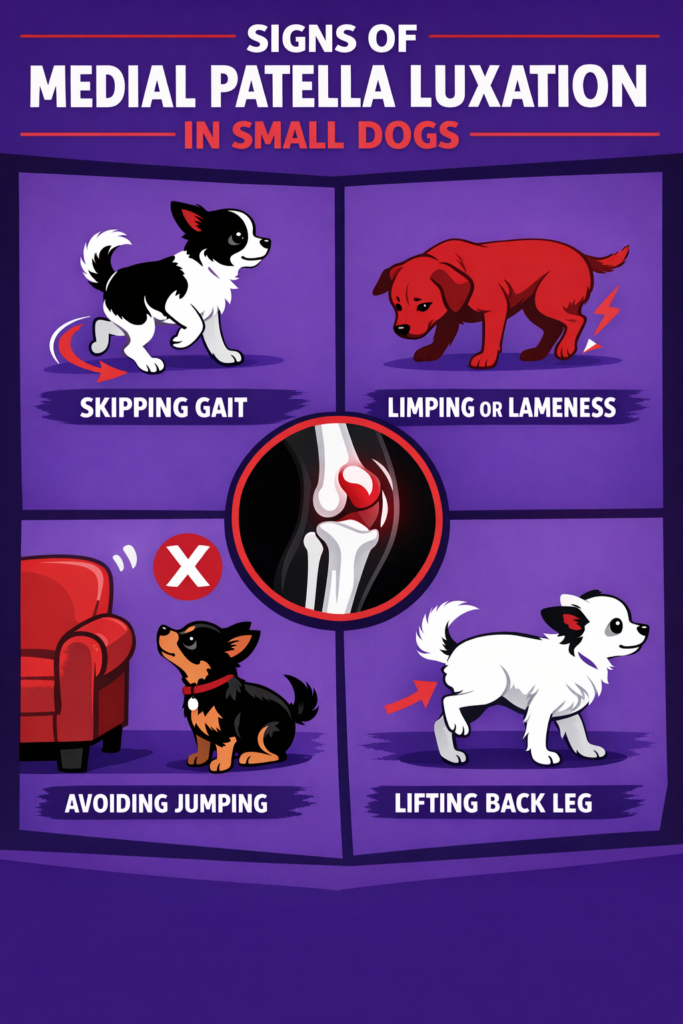
The most distinctive sign of medial patella luxation is the characteristic skipping gait. Your dog may suddenly lift their back leg for several steps before returning it to the ground and resuming normal walking. This happens when the kneecap slips out of place and then spontaneously pops back into position.
The severity of signs depends on the grade of luxation. Dogs with lower-grade luxations may show intermittent lameness that comes and goes, while more severely affected dogs may have difficulty extending their stifle joint and adopt a crouched, bow-legged stance. As the condition progresses, you may notice increased frequency of skipping episodes, reluctance to jump or climb stairs, or persistent lameness in one or both hind legs.
How MPL Is Diagnosed and Graded
Diagnosis begins with a thorough physical examination where we assess how easily the patella luxates and whether it stays in or out of position. We use a standardized grading system to categorize the severity. Grade I luxations occur only with pressure and immediately return to normal. Grade II luxations readily occur and tend to stay displaced but can be manually repositioned. Grade III means the patella remains luxated most of the time, while Grade IV indicates permanent luxation that cannot be repositioned.
Diagnostic imaging plays an important role in surgical planning. Radiographs help us evaluate skeletal deformities and assess the presence of arthritis, while advanced imaging, like CT scans, may be recommended in complex cases.
Surgical Solutions for MPL
Surgery is recommended when luxation causes persistent lameness, significantly impairs mobility, or progresses to higher grades. The goal of surgical correction is to realign the quadriceps mechanism and restore normal patellar tracking within the femoral groove.
Surgical techniques may include trochlear groove deepening to create a more stable channel for the patella, tibial tuberosity transposition to reposition where the patellar ligament attaches, imbrication of the joint capsule to tighten stretched tissues, and release of tight lateral structures. Many cases require a combination of these procedures to achieve optimal results. Our team has extensive experience with these advanced orthopedic procedures and uses modern surgical techniques to minimize complications.
Recovery typically involves several weeks of restricted activity, with gradual rehabilitation to rebuild muscle strength and joint stability. Most dogs achieve excellent functional outcomes, especially when surgery is performed before severe arthritis develops.
When to Consider Surgery for MPL in Your Small Dog
Not every dog with MPL requires immediate surgical intervention. Grade I luxations that cause minimal clinical signs may be managed conservatively with weight management and monitoring. However, surgery should be considered when luxation causes frequent lameness, limits your dog’s activity, or progresses to higher grades.
The timing of surgery matters. Early surgical intervention can prevent cartilage erosion and secondary osteoarthritis that develop when the patella repeatedly rubs abnormally against the femur. It’s also worth noting the connection between MPL and cruciate ligament injuries, as research indicates dogs with patellar luxation face an elevated risk of eventually rupturing their cranial cruciate ligament due to abnormal joint mechanics.
Get Comprehensive Orthopedic Care at Broadway Veterinary Hospital
Broadway Veterinary Hospital brings specialized expertise to orthopedic surgery for small animals. Dr. Sam Varon and Dr. Tyler Baum, both UC Davis graduates, have a particular interest and skill in advanced orthopedic procedures, including MPL repairs, TPLO surgery for cruciate tears, and fracture repair.
We understand that orthopedic surgery can feel overwhelming for pet owners, which is why we take time to thoroughly explain your dog’s condition and discuss all treatment options. Contact our office to schedule an orthopedic evaluation if you’re concerned about your small dog’s gait or knee stability.